

Although artificial intelligence has been developing in the background for decades, the dawning of the current AI era is often tied to the release of ChatGPT in late 2022. Since that pivotal moment, concerns about AI’s impact on the labor market have been sharply amplified in the public’s mind. The question is often framed as a binary outcome: Is AI like other inventions that ultimately created more jobs than it destroyed? Or is this a technology like no other that will lead to permanent job losses, reduced wages, and perhaps an end to cognitive labor altogether? Now, new research from Sania Edlich and Torsten Slok sheds some light on how the current labor market is changing in response to AI’s pressures.
Edlich and Slok reviewed data across 321 occupations and discovered that in jobs more exposed to AI, wage growth has been weaker since 2023. This occurred even as overall employment rates have held steady. Another study, by Ben Verschuere and Angus Cameron of Liminal Capital, found that hiring of 22- to 25-year-olds fell sharply in occupations they classified as more vulnerable to AI substitution, while firings held steady. These findings suggest a quieter adjustment is taking place: rather than firing current workers, employers may be slowing the hiring of new employees. Additionally, workers appear to have less bargaining power over pay.
For example, imagine a software company that uses AI to handle routine customer questions and prepare first drafts of reports. It may grow sales without laying off anyone. But when a support employee leaves, the company might decide that the remaining team and its AI tools can absorb the work. The existing employees may benefit from easier tasks, yet the next applicant faces one fewer opening. If several firms make similar decisions, the effect on new graduates can be substantial even while the overall unemployment rate looks healthy.
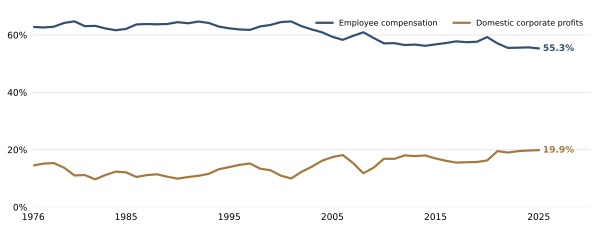
The chart above puts this recent development in a broader context. In 1976, employee compensation accounted for about 63% of the value added by U.S. corporations, while domestic corporate profits accounted for about 15%. In 2025, the corresponding figures were roughly 55% and 20%. Compensation includes benefits, as well as wages; and other items, such as depreciation, account for part of the remaining value. Over the long run, a smaller share of what corporations have produced has gone to their employees, while the share directed to capital (profits) has risen.
But note the timeframe — this shift began around the year 2001 and long before ChatGPT existed. There is not much evidence of a dramatic pickup in these trends since 2022. Global competition, automation, tax policy, changes in the mix of industries, and the business cycle also affect these shares. AI might be causing weaker hiring or lower pay in exposed occupations, but that is not evident (yet) in the aggregate statistics. Still, the mechanism described by employers in the new research is plausible, and it gives us something more useful to watch than layoffs alone.
What might happen next? Higher productivity can create new products, lower prices, and ultimately new kinds of work. Some firms using AI are actually hiring more people, and those with the skills to manage these systems are in demand. But there is no rule requiring the gains to arrive evenly or quickly. If employers can expand output without adding many people, and by paying them less, profits may rise for years while the path into a career becomes narrower.
For investors, stronger corporate margins can be welcome news. Yet owning stocks does not fully replace a good wage or a first rung on the career ladder, and the benefits of share ownership are not evenly distributed. The question, then, is no longer simply whether AI will destroy jobs. We should also ask how workers can share in the productivity they help create, and whether young people will still have a practical way to enter the fields that AI is changing most rapidly.
Sources:
https://www.nytimes.com/2026/09/16/business/ai-raises-hiring.html
Disclosure: The opinions expressed herein are those of Elevate Wealth Advisory (“EWA”) and are subject to change without notice. EW reserves the right to modify its current investment strategies and techniques based on changing market dynamics or client needs. This should not be considered investment advice or an offer to sell any product. Past performance is no guarantee of future results. This contains forecasts, estimates, beliefs and/or similar information (“forward looking information”). Forward looking information is subject to inherent uncertainties and qualifications and is based on numerous assumptions, in each case whether or not identified herein. It is provided for informational purposes only and should not be considered a recommendation to buy or sell securities or a guarantee of future results. EWA is an independent investment adviser registered under the Investment Advisers Act of 1940, as amended. Registration does not imply a certain level of skill or training. More information about EWA, including our investment strategies, fees and objectives can be found in our ADV Part 2, which is available upon request.