

The S&P 500 closed the month of May at another record high, capping its ninth consecutive weekly gain. The US stock market rebound from the March lows has been impressive – but it’s not just US large companies. In fact, most global equity markets now trade higher than on February 28, before hostilities began with Iran. This is despite sharply higher energy prices that remain elevated today.
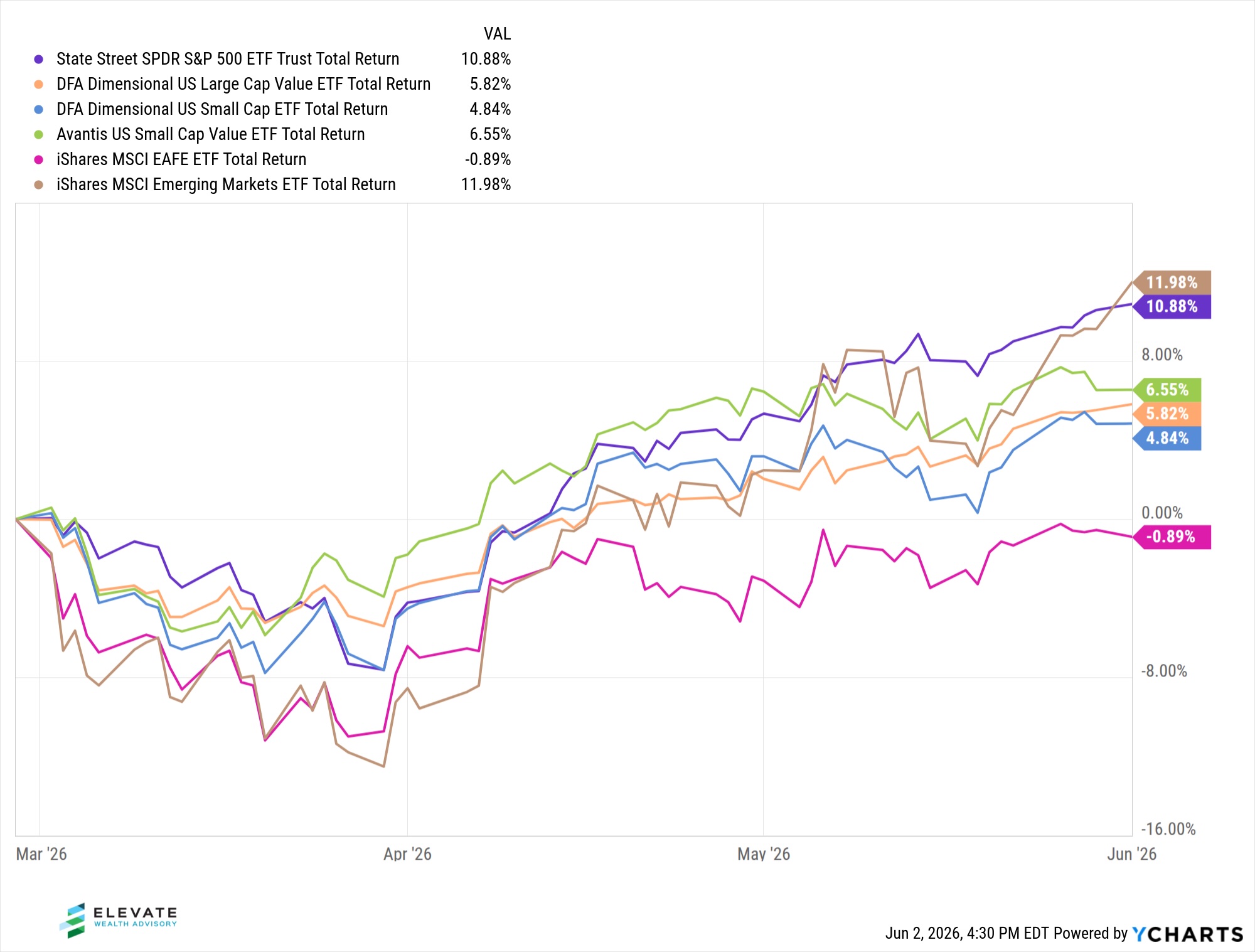
What makes this performance surprising is that stock markets have been able to move higher even as inflation pressures have reaccelerated, and as investors become more concerned that higher gasoline and diesel prices could weigh on both consumers and corporate profits. In prior eras, a spike in oil prices was often enough by itself to rattle the stock market. So why has the market remained so resilient, at least so far?
The simplest reason may be that corporate earnings have been very strong. According to FactSet, the blended year-over-year earnings growth rate for the S&P 500 in the first quarter of 2026 was 28.6%, which would mark the highest earnings growth rate since late 2021 if it holds. Even more striking, 84% of companies reporting had beaten earnings expectations, well above long-term averages. That matters because earnings are ultimately what stocks represent: claims on future corporate profits. When earnings are rising this quickly, markets can often absorb a meaningful amount of bad news elsewhere. The market may not be ignoring high energy prices so much as concluding that profit growth has been powerful enough to offset them.
Another reason is that energy represents a smaller share of the total economy than it once did. Today’s U.S. economy is more service-oriented, more technology-heavy, and less dependent on energy per dollar of output than it was in the 1970s, a decade that experienced two significant oil shocks. The United States now produces more of its own energy, uses energy more efficiently, and spends a smaller share of GDP on end-use energy than in prior decades. The Energy Information Administration has shown that U.S. energy expenditures fell to just 4.8% of GDP in 2020, the lowest share in data going back to 1970. That is very different from the world investors faced during the oil embargoes and inflation spirals of the 1970s. The economy is still vulnerable to energy shocks, but probably less so than it used to be.
A third possible explanation is fiscal policy. The Congressional Budget Office projects a federal budget deficit of 5.8% of GDP in 2026, following already-large deficits in recent years. Those deficits are not costless; they raise serious long-term concerns about debt, interest expense, and future policy constraints. But in the shorter run, large government deficits can also support aggregate demand and revenues in the private sector. It would be too simplistic to say deficits automatically cause profits to rise, but it is reasonable to think that an economy receiving this much fiscal support may be better able to tolerate expensive energy than one operating under tighter budget conditions.
Finally, there is the enormous AI infrastructure buildout, which may be dwarfing the impact of higher energy prices in investors’ minds. Markets are forward-looking, and right now a great deal of investor attention is centered on data centers, semiconductors, cloud infrastructure, and the capital spending required to support them. Goldman Sachs has estimated that AI investment could drive roughly 40% of S&P 500 earnings growth this year, with major cloud companies planning an estimated $670 billion of spending in 2026. Reuters has reported even larger estimates for AI-related capital expenditures across the ecosystem, describing a boom that now exceeds the scale of the late-1990s dot-com buildout. If investors believe that a multi-year AI investment cycle is underway, then a temporary spike in oil prices may be less significant in comparison.
All of these potential reasons do not mean the market will necessarily be proven “right”; large drawdowns are always a possibility. But for now, investors might be looking at strong earnings, a less energy-intensive economy, unusually large fiscal support, and a massive wave of AI-related capital spending and concluding that these combined forces are large enough to offset the drag from higher oil prices. Whether that judgment remains correct will depend in part on how long the conflict lasts, how high energy prices go, and whether inflation begins to spread more broadly through the economy. At least so far, the market appears to believe that overall, the positive forces have outweighed the negative ones.
Sources:
https://www.cbo.gov/publication/62105
Disclosure: The opinions expressed herein are those of Elevate Wealth Advisory (“EWA”) and are subject to change without notice. EWA reserves the right to modify its current investment strategies and techniques based on changing market dynamics or client needs. This should not be considered investment advice or an offer to sell any product. Past performance is no guarantee of future results. This contains forecasts, estimates, beliefs and/or similar information (“forward looking information”). Forward looking information is subject to inherent uncertainties and qualifications and is based on numerous assumptions, in each case whether or not identified herein. It is provided for informational purposes only and should not be considered a recommendation to buy or sell securities or a guarantee of future results. EWA is an independent investment adviser registered under the Investment Advisers Act of 1940, as amended. Registration does not imply a certain level of skill or training. More information about EWA, including our investment strategies, fees and objectives can be found in our ADV Part 2, which is available upon request.