

In the past five months, interest rates in the US have moved up significantly. While the rates on all maturities have climbed, US Treasury yields for bonds with maturities greater than 10 years are starting to approach 20-year highs. Elevated yields are beginning to impact mortgage rates as well; the average 30-year fixed rate recently hit a one year high of 6.7%. Higher interest rates are always a double-edged sword — improving interest income for savers but generally making life harder for borrowers. What is the market telling us about this latest rate move?
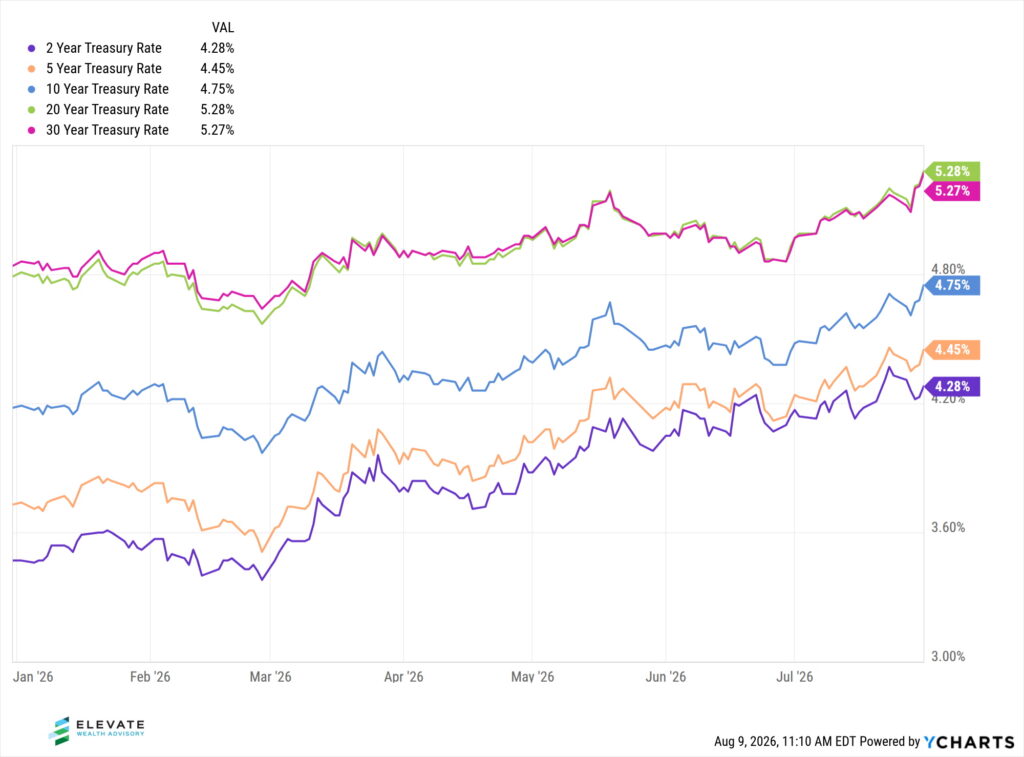
You can think of interest rates as the sum of two components: a “real” yield plus inflation expectations. Usually, bond investors expect to receive a positive “real” return, that is, a rate that compensates them for future inflation, plus an extra component related to the risk of holding that bond. What’s interesting about this latest move in rates is that it has been driven entirely by the real yield component. In fact, you can see on the chart below that ten-year future inflation expectations (the orange line) haven’t really moved at all since the end of 2025 and remain well-anchored.
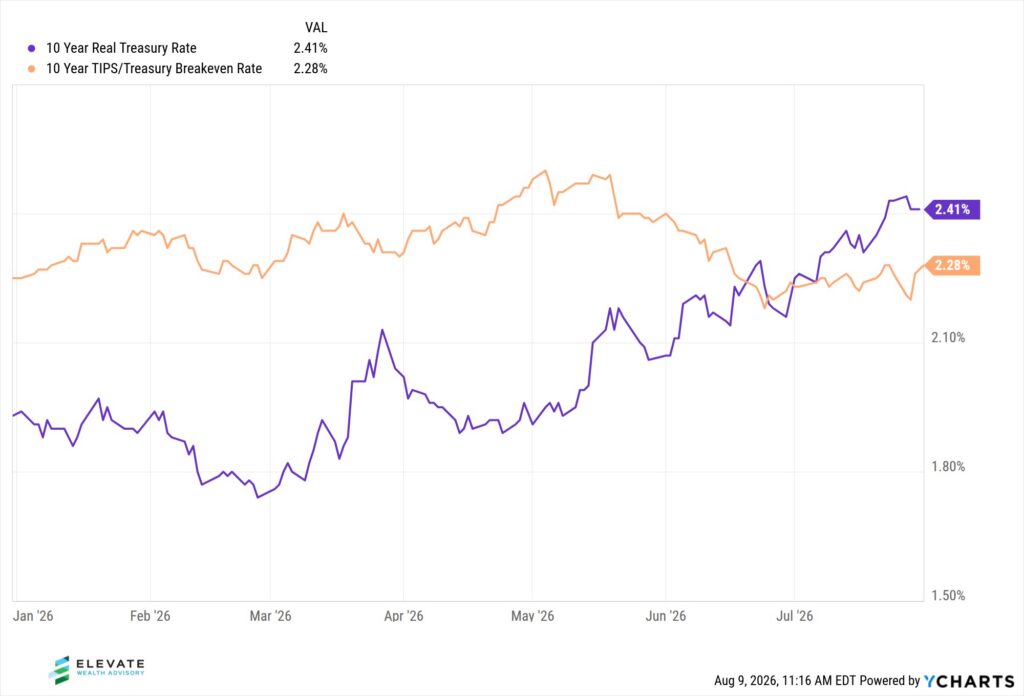
Now that we have a better understanding of what is driving the move higher in rates, we should probably re-phrase the question to “Why are realinterest rates rising?”
There are a few potential explanations:
First, supply matters. The federal government continues to run large budget deficits, which means the US Treasury must issue a large amount of debt to finance current spending, refinance maturing debt, and pay interest on the debt already outstanding. When the supply of bonds rises, investors generally require a higher yield to absorb that supply. This means that even the safest borrower in the world may have to pay more when it needs to borrow more.
Second, the Treasury is not the only borrower competing for capital. Large corporations, utilities, data center operators, and technology companies are all trying to finance an enormous buildout in artificial intelligence infrastructure. Some of these companies generate tremendous cash flow and historically did not need to rely heavily on debt markets. But the scale of the current AI investment cycle is large enough that it may be competing with the government for the same pool of long-term savings. Higher demand for capital can push real yields higher, even when inflation expectations remain stable.
Third, 2026 has brought some unwelcome weakness in the Japanese yen. When the yen weakens too much, Japanese authorities may feel pressure to support their currency by selling dollars and buying yen. Since Japan has long been one of the largest foreign holders of Treasury securities, some investors are concerned that Japan may resort to U.S. Treasury bond sales to defend their currency.
Finally, higher real yields may also reflect a more resilient economy. If investors believe the economy can grow faster than previously expected, perhaps because of productivity gains from technology or simply continued strength in household and corporate balance sheets, then the “normal” level of real interest rates may be higher than it was in the 2010s. In other words, some of the move may simply be because the economy is seen as strong enough to tolerate higher rates.
How can investors take advantage of historically high real yields?
The most direct way is through Treasury Inflation-Protected Securities, or TIPS. A TIPS bond purchased today locks in a real (inflation-adjusted) yield if it is held to maturity. The principal value adjusts with inflation, and the coupon is paid on that inflation-adjusted principal amount. That means the investor earns the stated real yield plus whatever inflation actually turns out to be. If inflation is higher than expected, TIPS should generally outperform comparable nominal Treasuries. If inflation is lower than expected, nominal Treasuries may do better. Note that TIPS have unique taxable income treatment and may not make sense to hold in every kind of account.
The sharp rise in interest rates this year has been painful for borrowers and unsettling for investors, but it is not entirely bad news. Higher real yields mean the market is offering a better inflation-adjusted return on high-quality bonds than it has for most of the past two decades. That does not eliminate risk, and it certainly does not make timing interest rates easy, but it does improve the opportunity set. For long-term, patient investors, today’s higher real yields may be a useful planning tool for diversified portfolios.
Sources:
- YCharts
- U.S. Department of the Treasury
- TreasuryDirect
- Federal Reserve
- Federal Reserve Bank of New York
Disclosure: The opinions expressed herein are those of Elevate Wealth Advisory (“EWA”) and are subject to change without notice. EWA reserves the right to modify its current investment strategies and techniques based on changing market dynamics or client needs. This should not be considered investment advice or an offer to sell any product. Past performance is no guarantee of future results. This contains forecasts, estimates, beliefs and/or similar information (“forward looking information”). Forward looking information is subject to inherent uncertainties and qualifications and is based on numerous assumptions, in each case whether or not identified herein. It is provided for informational purposes only and should not be considered a recommendation to buy or sell securities or a guarantee of future results. EWA is an independent investment adviser registered under the Investment Advisers Act of 1940, as amended. Registration does not imply a certain level of skill or training. More information about EWA, including our investment strategies, fees and objectives can be found in our ADV Part 2, which is available upon request.