

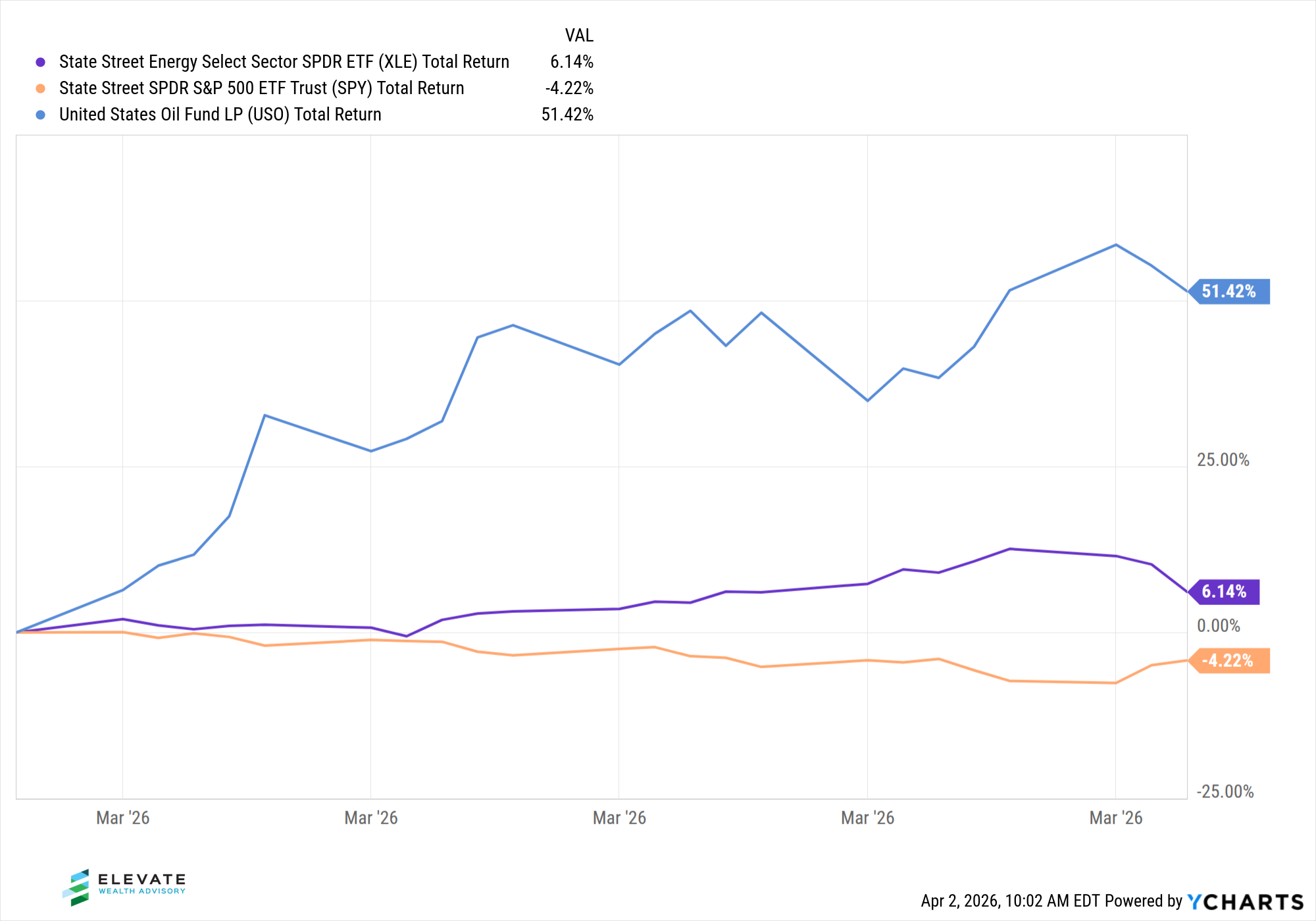
In my January 2026 post “Four Market Surprises from 2025,” I highlighted the collapse in oil prices as one of the biggest surprises of the year. But as we know, market conditions can change quickly, and the price of oil and gasoline has risen dramatically since the beginning of hostilities in Iran. Crude oil was up more than 50% in the month of March, and the average retail price of gasoline recently hit $4/gallon. High energy prices are starting to drive serious investor concerns about inflation, economic growth and interest rates that may remain higher for longer.
War is among the greatest uncertainties that investors ever face; the duration of the conflict and many of the longer-term aftershocks are still largely unknown. With global stocks down around 6% since February, many investors are understandably wondering if portfolios could be designed to protect against the risk of higher energy prices that wars in the Middle East often spark. After all, in today’s rich marketplace of investment options, there is probably an exchange-traded fund (ETF) that covers almost any asset or viewpoint an investor may care to express.
But this is one of those problems that seems easy to solve in theory but is actually very difficult in practice. Let’s consider two potential options. First, and perhaps the most straightforward, an investor trying to protect themselves against high energy prices could choose to hold the US Oil Fund LP ETF (“USO”), which seeks to track the price of crude oil itself. USO was up sharply in March, more than 50% in fact, and would certainly have blunted the impact of the last month’s stock market decline. Another option would be to hold an ETF that invests in a basket of energy stocks. For example, the State Street Energy Select SPDR (“XLE”), the largest ETF that concentrates on energy companies, rose 6% last month while the S&P 500 fell more than 4%. Either of these ETFs would have hedged a diversified portfolio of stocks and bonds quite well in March.
But the picture changes considerably when we zoom out and examine longer timeframes. For the 15 years leading up to February 28, 2026, USO holders would have lost nearly 74% of their money*. Last month’s +50% return brought USO’s total loss to -59% since 2011. XLE holders would have fared a lot better with an annual return of +5.9% since 2011, however, XLE still significantly underperformed the S&P 500 over that 15-year period, which returned +13.5% per year. Outperforming the S&P 500 by 10% last month was no doubt elating for XLE holders, but anyone holding it since 2011 gave up more than 400% in total return for that ‘protection.’
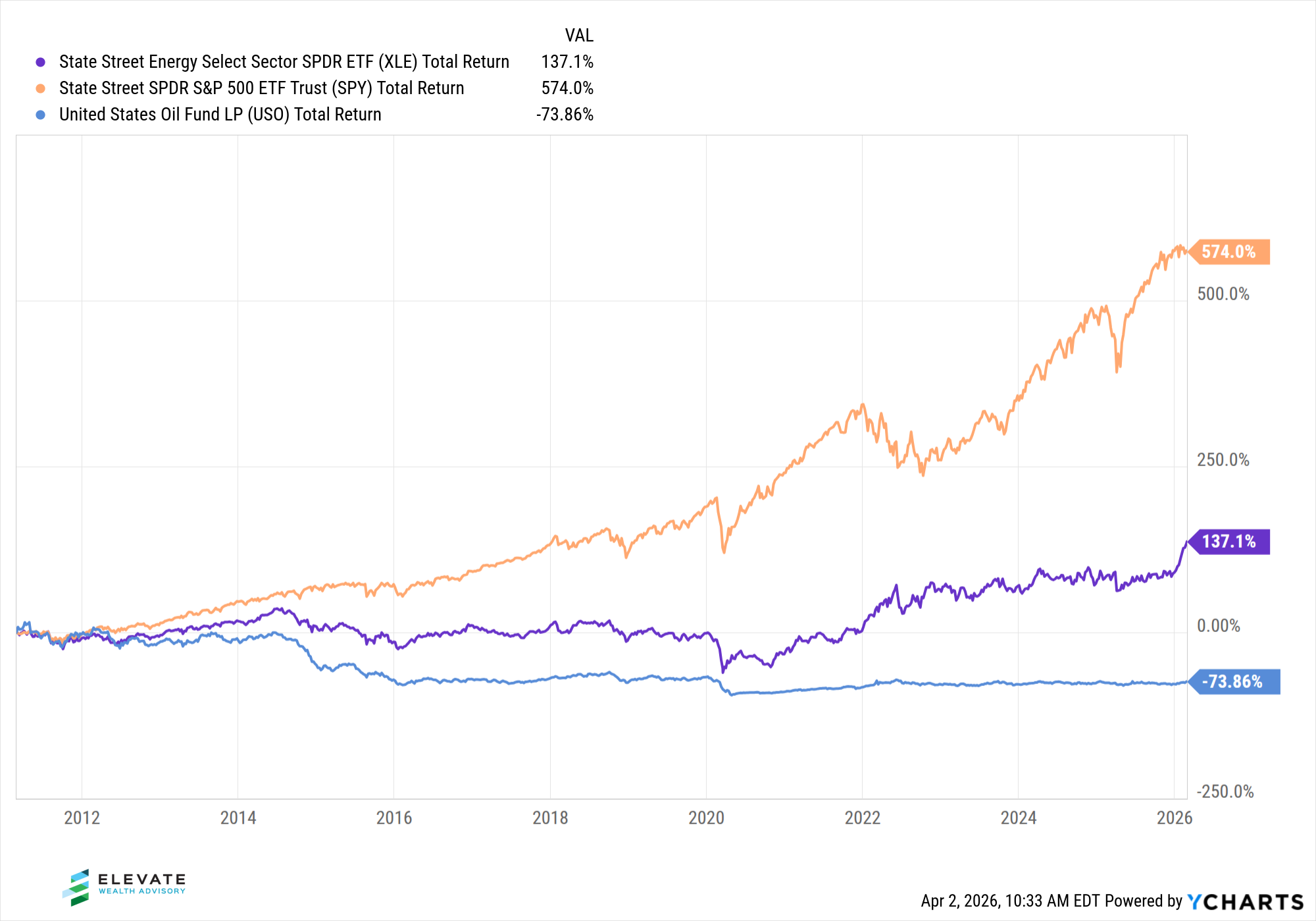
Comparing these hedging strategies under different timeframes takes us straight to the crux of the problem – we can’t predict energy price spikes in advance. While hedges can work well in the short term, they only do so when you can get the timing exactly right. And as evidence-based investors, we know that market timing is extraordinarily difficult, even for professional investors.
It is important to note here that diversified investors already hold energy stocks in their portfolio; the energy sector comprises about 4% of the S&P 500. And this is a good thing! Last month’s returns demonstrated why it is important to be diversified across different sectors; energy’s strong outperformance in March helped to cushion the overall drawdown in US stocks to some extent.
The main takeaway is that investors do not need a perfect hedge for every geopolitical shock. They need a durable, broadly diversified portfolio that is built to withstand many different environments, including sudden spikes in oil and gasoline prices. Energy shocks can be painful, but they have historically been temporary. Investors who stay diversified and resist the urge to chase narrow hedges are likely to be better served over time than those trying to predict when the next spike will arrive—and when it will end.
*For illustrative purposes only. USO is not designed to be a long-term investment and does not track the price of oil on longer timeframes. USO invests in oil futures contracts and must “roll forward” each future when the contract expires. When the futures price is higher than the current (expiration) price, USO must sell lower-priced contracts and purchase higher-priced ones. This process can create a persistent performance drag relative to crude oil prices, often causing USO to underperform the actual spot price of oil over longer periods of time.
Sources:
Disclosure: The opinions expressed herein are those of Elevate Wealth Advisory (“EWA”) and are subject to change without notice. EWAreserves the right to modify its current investment strategies and techniques based on changing market dynamics or client needs. This should not be considered investment advice or an offer to sell any product. Past performance is no guarantee of future results. This contains forecasts, estimates, beliefs and/or similar information (“forward looking information”). Forward looking information is subject to inherent uncertainties and qualifications and is based on numerous assumptions, in each case whether or not identified herein. It is provided for informational purposes only and should not be considered a recommendation to buy or sell securities or a guarantee of future results. EWA is an independent investment adviser registered under the Investment Advisers Act of 1940, as amended. Registration does not imply a certain level of skill or training. More information about EWA, including our investment strategies, fees and objectives can be found in our ADV Part 2, which is available upon request.