

The current dividend yield on the S&P 500 index is about 1.25%, which is very close to its all-time historical low of 1.08% in the summer of 2000. Investors seeking income are unlikely to invest exclusively in the S&P 500, therefore, and will tend to focus on higher yielding instruments such as bonds, real estate and perhaps annuities. But for investors who desire equity exposure and high income in the same package, Wall Street has obliged with several “high yield” equity funds to meet demand. In this month’s post, we examine two of the more popular high yield equity funds, “J.P. Morgan Equity Premium Income ETF” (JEPI), and “Neos S&P 500 High Income ETF” (SPYI), to understand their strategy better and to answer the question “What do investors in these funds give up in exchange for higher income?”
Compared to the S&P 500, the yields on JEPI and SPYI are eye-popping. JEPI currently yields 8.22% while SPYI boasts an even higher yield of 12.2%. The main investment strategy employed by both funds (“covered call writing on the index”), is the same, however there are some differences between the two funds as well. While SPYI generally holds the same stocks as the S&P 500 itself, and in roughly the same weights, JEPI does not try to replicate the index. Instead, JEPI is actively managed, and includes US large companies that its fund managers believe are defensive in nature, undervalued, and less volatile than the average stock.
So how do these two funds achieve such high payout ratios? The main way is by earning extra income by selling options on a basket of similar stocks to the ones they own in the fund. The strategy is called “covered call” because they are selling call options, and they are “covered” because the fund also owns the underlying assets that the option is written on. (Note that “call” options give the owner the right to buy an asset in the future at a pre-determined price, whereas “put” options are the opposite and grant the owner the right to sell something at a pre-determined price.)
Since these options have value, the fund is able to ‘earn’ extra income by selling them. But as they say, there is no such thing as a free lunch… so what do investors give up in return for this extra income? The following chart will help to illustrate:
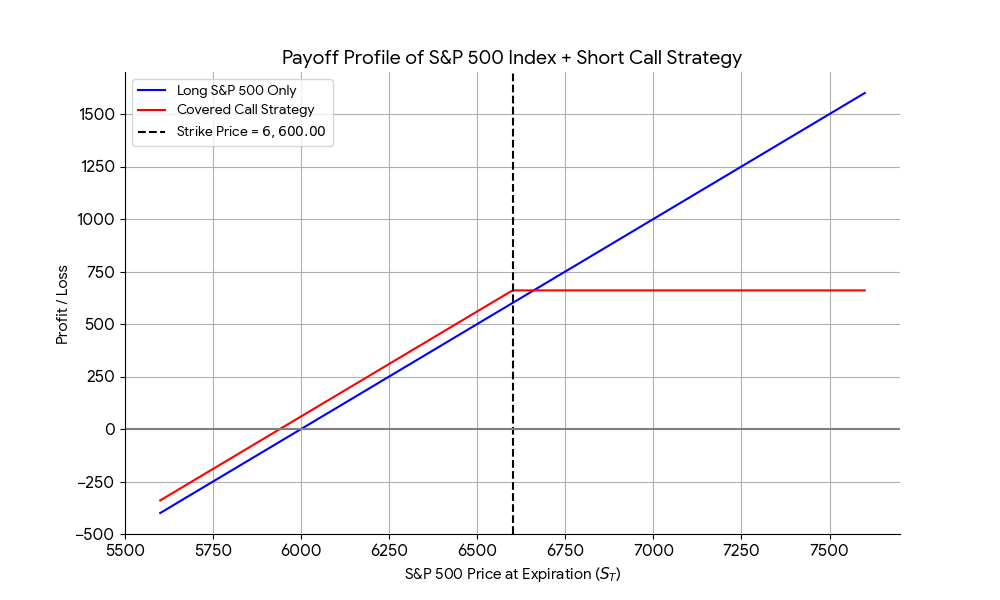
The red line on the chart above shows the payoff to the kind of covered call strategy that funds like JEPI and SPYI pursue. Note that below a price of 6,600 on the index, the payoff is slightly higher for the covered call strategy than just owning the index itself (blue line), due to the extra income provided by selling the option. But above 6,600, the options would be “exercised” by the holders, capping the upside potential on further equity price appreciation. This is what an investor trades away for higher income in most “high yield” equity funds.
Now you may be wondering, how does the total return of these funds compare to simply owning an S&P 500 index fund? After all, some investors are actively seeking high current yields, and would be happy to limit their capital appreciation, and have their investment returns delivered to them in the form of dividends, rather than capital gains. In other words, if the total returns are similar, but just delivered in different forms, then funds like JEPI and SPYI may still be attractive investments (compared to the S&P) for a certain subset of “income” investors. The chart below, showing the three-year total return for each fund compared to an S&P 500 index fund, is enlightening:

Since August 31, 2022, the S&P 500 has returned 65.6% while SPYI has returned 47.6%, an 18% underperformance on a total return basis. Note that SPYI holds the same stocks as the index, so this is a pretty fair comparison to make. The performance of JEPI lags the S&P 500 by an even greater margin (35%), returning just 30.6% over the same timeframe. The underperformance here stems from a combination of (1) holding different stocks that underperformed the index and (2) not receiving enough option premium to fully compensate for the capped upside on the equity exposure. From these two examples anyway, it seems that investors are giving up a great deal, especially in bull markets when call options are more likely to be exercised.
High yield equity funds like JEPI and SPYI may still have a role to play in the portfolios of certain “income” investors, but they should consider buying these funds with eyes wide open. Investors should understand that these kinds of funds are very likely to underperform the S&P 500 index, perhaps significantly, and especially in bull markets like we’ve experienced since the fall of 2022. Due to its deeper value and “lower volatility” components, JEPI is likely to fare better than SPYI (and the S&P 500 itself) in a prolonged bear market. This defensive posture, alongside a high current yield, may be reason enough for some risk averse investors to consider JEPI, but in general, most investors would probably be better off by separating their “capital appreciation” securities from their “income producing” securities.
Sources:
https://www.gurufocus.com/economic_indicators/150/sp-500-dividend-yield