

One of the first lessons you learn in Investments 101 is that risk and return are related. As evidence-based investors, this feature of capital markets is a core part of our investment philosophy and helps to explain why stocks have dramatically outperformed bonds over the long run. Stocks are risky investments to be sure, but historically, investors have been compensated for taking that risk with high realized returns. One dollar invested in the S&P 500 over the past 100 years has grown to more than $1,000 in real (inflation-adjusted) terms. In contrast, a dollar invested in short-term Treasury bills has grown to only about $1.35 in real terms over the same timeframe. In other words, T-bills, while very safe, are an unlikely vehicle for building significant wealth over an investment lifetime.
The tight relationship between risk and return can often be seen within asset classes as well; the bond market in 2025 has demonstrated this principle clearly. The $150 trillion global bond market is a very broad asset class; there are many different segments of the bond market, each with their own risk and return characteristics. In general, bond market returns are driven by two main factors:
TERM (the length of time until the bond matures, from overnight to several decades)
CREDIT (the default risk of the bond, i.e. the likelihood of a late or missed payment)
Long-term bonds usually have higher yields than short-term bonds for two main reasons. First, they are much more sensitive to changes in interest rates and inflation, and secondly, a longer maturity leaves more runway for unexpected things to happen — especially negative shocks that might impact a bond issuer’s ability to make interest and principal payments over the full life of the bond.
Every bond has a specific credit risk as well, and bond issuers are “rated” by credit agencies to help investors estimate this risk. Highly rated (lower risk) sovereign governments like the United States can usually borrow at attractive (low) rates whereas corporate borrowers with weaker fundamentals tend to issue “high yield” bonds to entice borrowers to accept a higher risk of default. Lower risk corporate borrowers with solid fundamentals, known as “investment-grade,” occupy a risk level somewhere in the middle of the range.
Year to date, bond market returns have been tracking both dimensions of risk closely, demonstrating the natural relationship between risk and return:
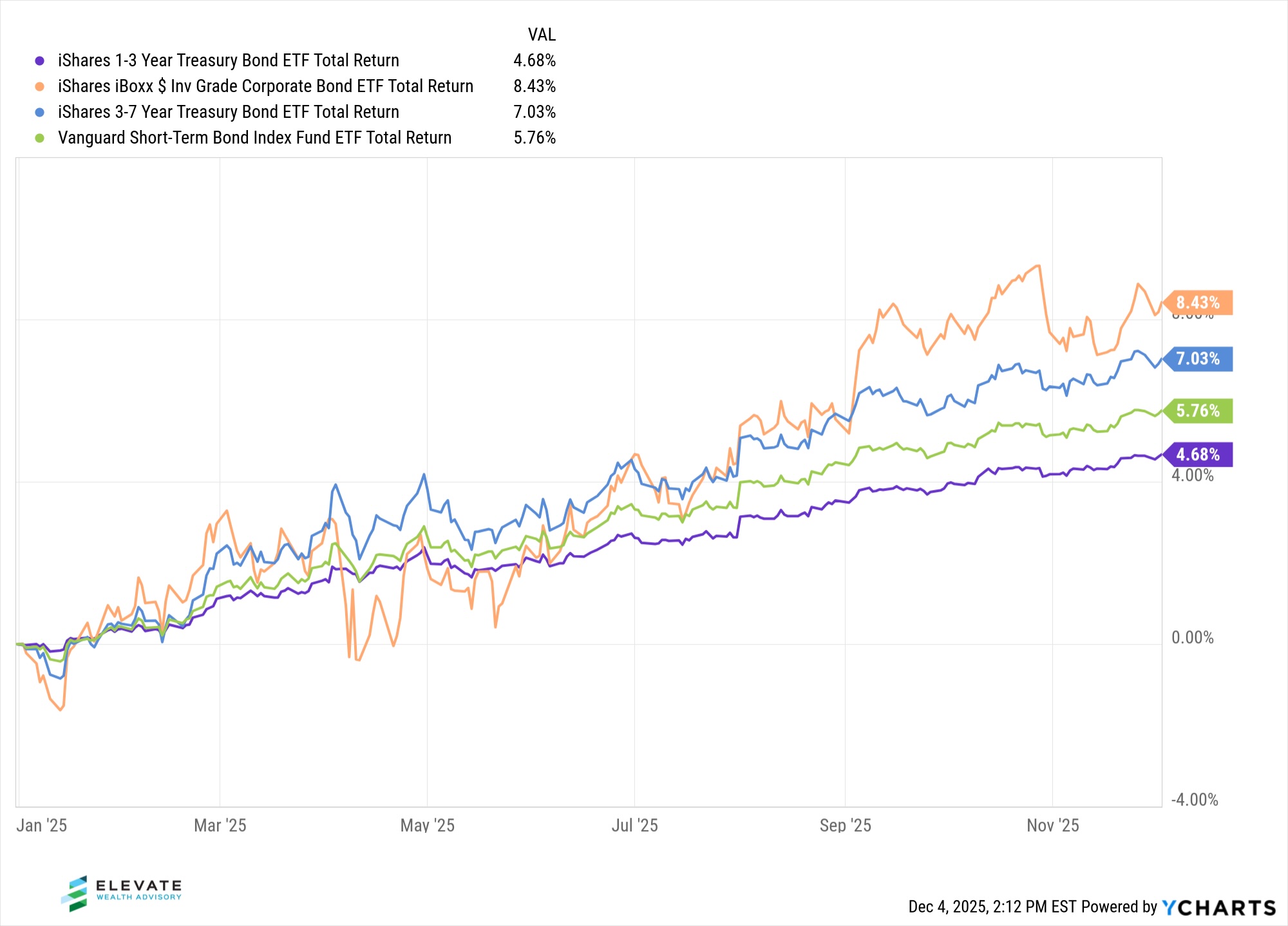
Notice how jagged and volatile the orange line is, which depicts year-to-date returns on intermediate-term corporate bonds. In contrast, the return line for short-term Treasury bonds (in purple) is relatively smooth and flat. Longer-term corporate bonds are clearly riskier than short-term government bonds, but investors in corporate credit have been compensated with higher returns this year for taking on that extra risk. In fact, the return on intermediate-term corporate bonds (+8.4%) is nearly double that of short-term US Treasury bonds (+4.7%) through November of 2025.
While bond market returns have tracked underlying risk closely in 2025, this is not the case in all periods. Markets remain as unpredictable as ever and don’t always follow the script in the short run. But in the long run, we expect that risk and return will continue to share a fundamental relationship, and one that plays a key role in intelligent portfolio design.
Sources:
https://ofdollarsanddata.com/sp500-calculator/
Disclosure: The opinions expressed herein are those of Elevate Wealth Advisory (“EWA”) and are subject to change without notice. EWA reserves the right to modify its current investment strategies and techniques based on changing market dynamics or client needs. This should not be considered investment advice or an offer to sell any product. Past performance is no guarantee of future results. This contains forecasts, estimates, beliefs and/or similar information (“forward looking information”). Forward looking information is subject to inherent uncertainties and qualifications and is based on numerous assumptions, in each case whether or not identified herein. It is provided for informational purposes only and should not be considered a recommendation to buy or sell securities or a guarantee of future results. EWA is an independent investment adviser registered under the Investment Advisers Act of 1940, as amended. Registration does not imply a certain level of skill or training. More information about EWA, including our investment strategies, fees and objectives can be found in our ADV Part 2, which is available upon request.