

Two years ago, in a blog post titled “Worried about the National Debt?”, I compared our government’s fiscal situation with that of Japan. The point was to remind investors that high debt levels do not necessarily imply high inflation, and that sovereign currency-issuing governments, like the United States, retain powerful tools at their disposal to contain interest rates, if necessary. With the national debt having exceeded $40TT in the past few weeks, I’d like to update that post and include some actionable investment ideas for investors that are particularly concerned about spiraling US debt levels.
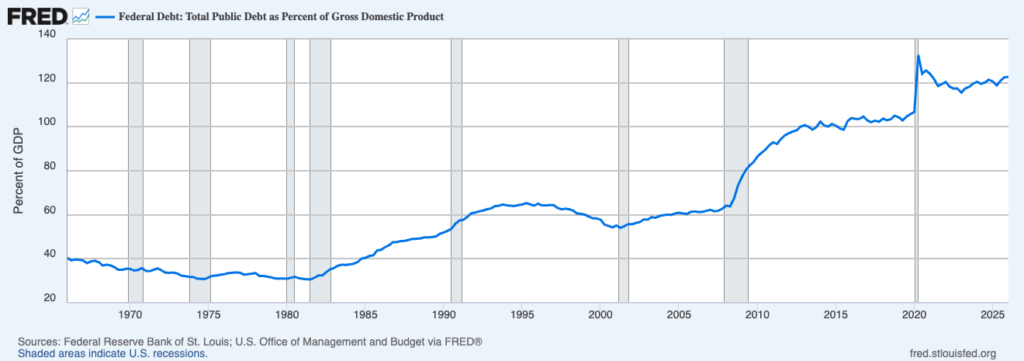
First, some background. As a percent of Gross Domestic Product, our total federal government debt has reached 123%. We’ve actually been here before…this is the same ratio that we experienced in the immediate aftermath of World War II. Then, as now, the solution to our debt burden is to grow nominal GDP* at a rate that exceeds the average annual % deficit. Why is that so important? If the size of our economy can grow faster than our annual budget deficits, our national debt burden will shrink over time. The goal, therefore, comes down to a simple formula:
Nominal GDP Growth % > Annual Budget Deficit %
On this metric, the US has been running in place for about five years now. While nominal GDP has been strong (~6-7%), annual deficits have closely matched that pace since 2021. This means that although total debt levels have climbed steeply in the past five years, our debt burden, relative to the economy, has remained constant. You can see this on the chart above. Following the Covid-era spike, the curve has now flattened, and we are roughly in the same position as we were in 2021. The good news is that there are many ways to bring down the debt burden from here. Among the potential solutions are an improvement in economic growth, a rise in inflation, higher taxes, or a modest deficit reduction (lower spending).
Note that high debt levels can co-exist with strong stock market returns. During WWII and in the post-war period, the stock market performed strongly, returning +15.4% annualized between 1942 and 1952, and it experienced only one negative year (1946). Although inflation was high during this period, as well, the stock market outperformed the rate of inflation, delivering positive real returns over those 10 years.
How to Address These Concerns in a Portfolio
I want to stress that what follows is just a thought experiment – everyone’s financial situation and risk tolerance is unique, and this is not investment advice. Additionally, we can’t predict how markets or the US government will ultimately respond to higher debt levels and interest costs. But, for investors who are very worried about the national debt, their concerns tend to gravitate toward three market scenarios. Below I’ve listed each scenario, alongside potential ways to mitigate their impact in a portfolio:
- Higher Interest Rates: Own Short-term, High-quality Bonds Long term bonds are much more sensitive to changes in interest rates than short term bonds. This means that in a rising rate environment, for example, longer-term bonds will suffer greater price declines than short-term bonds. Because they mature sooner, short-term bonds allow for the earlier reinvestment of principal, allowing them to take advantage of higher rates more quickly than long term bonds.
- Higher Inflation: Own Treasury Inflation-Protected Securities The US government began issuing a new type of Treasury security (“TIPS”) in 1997 that protects a holder’s principal and interest from unexpected increases in inflation. An investor in TIPS locks in a “real” yield (after inflation) for the bond’s full term. The inflation protection feature makes them an attractive option for investors concerned about inflation’s effect on their future purchasing power.
- A Weaker US Dollar: Own Equities (Including Foreign Stocks) Public company managers have demonstrated a remarkable ability over the decades to adapt and thrive in all kinds of economic environments, including during periods of higher inflation. Overall, the US stock market has returned more than 6% above the rate of inflation for the past 100 years, making stocks an essential element for well-designed portfolios to grow purchasing power over time. For US based investors, owning foreign stocks has another potential benefit – if the US dollar depreciates in value, your total US dollar return is enhanced through exchange rate (currency) effects.
Note that none of these are radical ideas or esoteric investments. In fact, for practitioners of evidence-based investing, these investments already fit well in the context of our investment philosophy. Thought experiments like this one can help to remind us that a well-designed portfolio is prepared for a wide variety of market environments. If you are already a globally diversified investor, you may be in better shape than you realized for the scenarios outlined above.
*GDP is usually reported in “real” terms. Nominal GDP = Real GDP + Inflation.
Source: https://fred.stlouisfed.org/
Disclosure: The opinions expressed herein are those of Elevate Wealth Advisory (“EWA”) and are subject to change without notice. EWA reserves the right to modify its current investment strategies and techniques based on changing market dynamics or client needs. This should not be considered investment advice or an offer to sell any product. Past performance is no guarantee of future results. This contains forecasts, estimates, beliefs and/or similar information (“forward looking information”). Forward looking information is subject to inherent uncertainties and qualifications and is based on numerous assumptions, in each case whether or not identified herein. It is provided for informational purposes only and should not be considered a recommendation to buy or sell securities or a guarantee of future results. EWA is an independent investment adviser registered under the Investment Advisers Act of 1940, as amended. Registration does not imply a certain level of skill or training. More information about EWA, including our investment strategies, fees and objectives can be found in our ADV Part 2, which is available upon request.