

I like to remind my kids sometimes that when their mom and I got married, we had nothing. We actually had less than nothing because our debts, mostly student loans, far exceeded our assets. But we did have two other very important things: the brains in our heads, and a commitment to start saving and building wealth as early as possible. In a few years, when my children begin their careers, I suspect they will both be in a similar position. Rather than being discouraged, I want them to embrace the challenge before them.
First, they’ll need to understand that preparing for a financially secure retirement is a multi-decade long project. There are many ups and downs on that long journey, as well as unpredictable twists and turns. Early on, it can appear that very little progress is being made; the dollar amounts involved are usually small, and it can be hard to dig out of debt — especially if the interest rates are high. They should also understand that most of the “magic” of compounding returns occurs in the final few years, but that it often doesn’t feel like that will ever happen in the beginning.
Secondly, I want them to know that there are three helpful milestones that can guide them along the way. Each goal should be celebrated individually as an accomplishment and can hopefully assure them that they are in fact on the right track. The second two milestones are especially useful because they demonstrate how the balance is slowly shifting from your labor doing all the work to your money beginning to do some of the work for you.
The first milestone is when your net worth changes from negative to positive.
For many young workers and recent graduates, the first few years of adult financial life can feel like running uphill. Student loans, car loans, credit card balances, and the general cost of getting established can easily exceed whatever small amount has been accumulated in checking, savings, or a first retirement account. In that stage, net worth may be negative even for someone who is doing everything right. But each loan payment is doing two things at once: it is reducing liabilities and gradually pushing them closer to a positive net worth. Eventually, as the debts shrink, assets grow enough that the balance sheet finally crosses into the black. That may not sound glamorous, but it is a major accomplishment, and it means that the real building phase can begin.
The second milestone is when your portfolio saves more than you do – in other words, the portfolio itself may now be adding as much wealth in a typical year as the worker is contributing from wages. This milestone usually arrives more quietly, but it may be even more powerful. Early in a career, annual savings typically matter far more than portfolio returns because the account balance is still small. If someone earns $75,000 per year and saves 20%, they are adding $15,000 per year to their portfolio. At that stage, a $25,000 or $50,000 account is helpful, but it is not yet doing the heavy lifting. However, if that same worker eventually accumulates about $200,000 in an 80/20 portfolio, a reasonable long-term average return assumption of 7.5% would equal roughly $15,000 per year, an amount equivalent to their own annual savings.

The third milestone is when your portfolio works harder than you do. This is when the portfolio’s expected annual return becomes comparable to, or even greater than, the income generated from work. Not everyone reaches this exact point before retirement, and that is perfectly fine. Social Security, pensions, part-time work, lower taxes, reduced savings needs, and changes in spending can all reduce the amount the portfolio must provide. For example, a worker earning $150,000 at the end of a career might expect $60,000 per year from Social Security; their portfolio will need to provide the remaining $90,000. At a 6% average annual return assumption, a $1.5 million portfolio would be expected to produce approximately that amount in an average year.
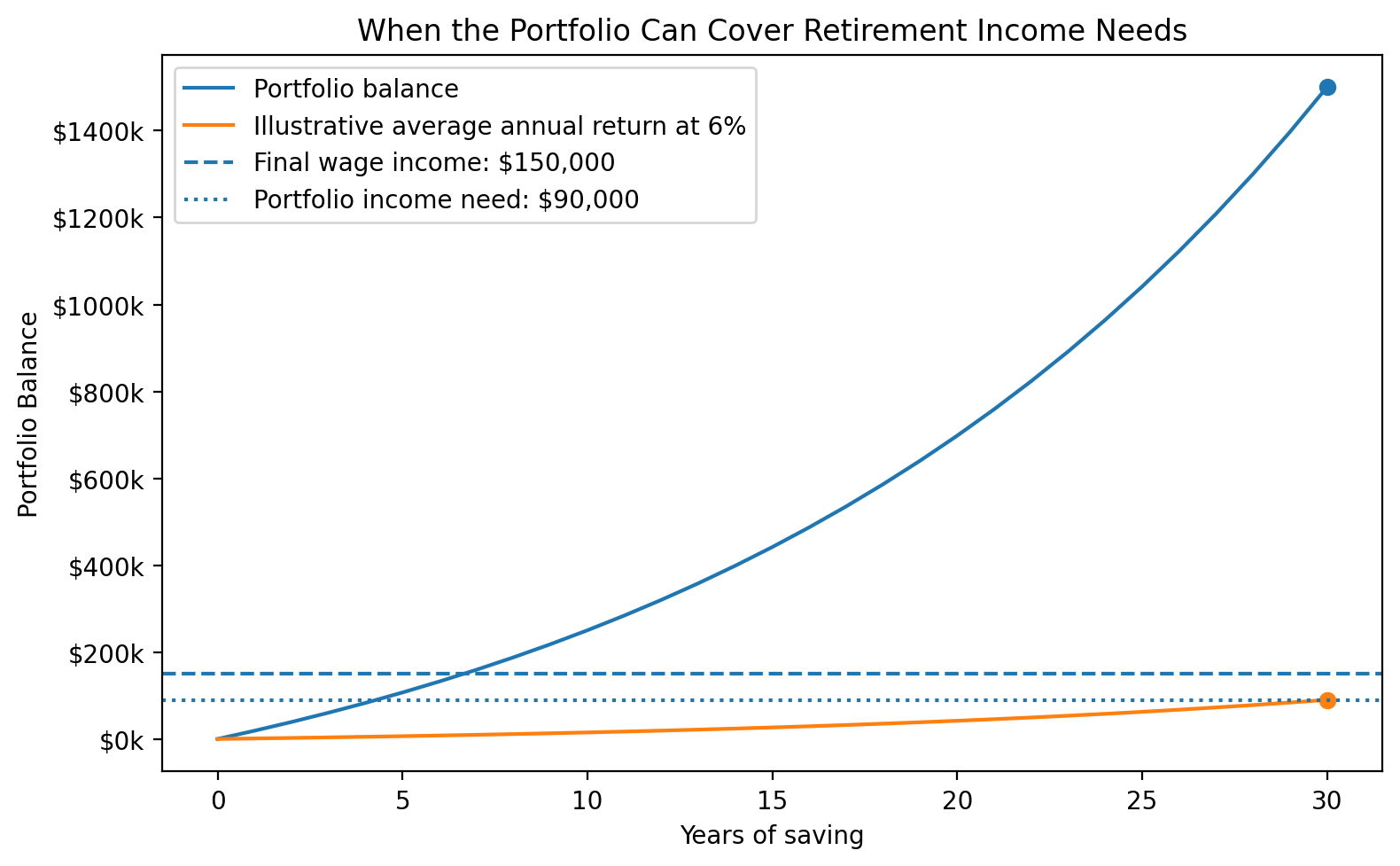
When my kids first start out on the road to retirement, I want them to know that most of the progress is easy to miss while it is happening. Paying down debt, achieving a positive net worth, and eventually seeing the portfolio produce a meaningful share of future income needs are all signs that the plan is working. While there is a lot more to a successful retirement than just having healthy account balances, each of these milestones will hopefully provide encouragement along the way.
Disclosure: The opinions expressed herein are those of Elevate Wealth Advisory (EWA) and are subject to change without notice. EWA reserves the right to modify its current investment strategies and techniques based on changing market dynamics or client needs. This should not be considered investment advice or an offer to sell any product. Past performance is no guarantee of future results. his contains forecasts, estimates, beliefs and/or similar information (“forward looking information”). Forward looking information is subject to inherent uncertainties and qualifications and is based on numerous assumptions, in each case whether or not identified herein. It is provided for informational purposes only and should not be considered a recommendation to buy or sell securities or a guarantee of future results. EWA is an independent investment adviser registered under the Investment Advisers Act of 1940, as amended. Registration does not imply a certain level of skill or training. More information about EWA, including our investment strategies, fees and objectives can be found in our ADV Part 2, which is available upon request.